India Series: The Waste We Choose Not to See

From Delhi’s garbage mountains to the shopping habits that sustain a disposable economy
A ₹200 top feels like a small reward. It fits the trend and will look good in the photos. The buyer seldom pauses to imagine its destination after the last wear. Elsewhere in Delhi, waste rises above the rooftops at Ghazipur. Between the market stall and the garbage mountain lies a chain of decisions we seldom follow. Even a shopper who cares about the planet can lose sight of it.
The Mountain Delhi Keeps Adding To
Delhi’s dumpsites give the phrase “waste crisis” a physical presence. The Economic Survey of Delhi 2025–26 reports that 74.11 lakh tonnes of legacy waste were remediated at Ghazipur, Bhalswa and Okhla between April 2025 and February 2026. During the same period, 30.74 lakh tonnes of fresh waste were disposed of at these sites. At the end of the reporting period, 120.82 lakh tonnes of legacy waste remained [1].

Removing accumulated waste is progress. Fresh deposits, however, keep the sites tied to the system that created them. Clearing a mountain does little to end the problem if the city keeps supplying material for another.
Reading the Figures Carefully
The surveys use different starting points. The 2023–24 edition records a July 2019 baseline of 280 lakh tonnes across the three sites [2]. The 2025–26 table uses a June 2022 drone assessment of 203 lakh tonnes above ground [1]. Subtracting figures drawn from different dates and methods would give a misleading account of the waste removed. The latest table also describes a fixed reporting period rather than a live total.
Where the Removed Waste Goes
Biomining sorts old waste into separate fractions. Combustible material is separated from construction-related material and inert residues. Depending on their suitability and the safeguards in place, some fractions may enter industrial processes or construction. The Delhi administration has described supplies of refuse-derived fuel to cement companies and other destinations for processed material [3].
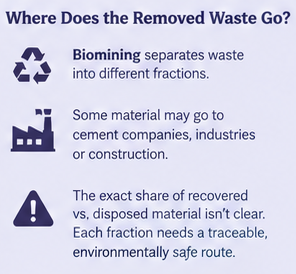
The destination matters as much as the amount removed. Public figures do not fully establish the share recovered for reuse or the share that needs further treatment and disposal. Nor does removal alone establish that each destination is environmentally safe. Calling the entire process a transfer of waste would overlook recovery. Assuming every tonne has been safely handled would overlook the evidence still needed. Each fraction needs a traceable route beyond the dumpsite.
Life Beyond the Dumpsite Boundary
Central Pollution Control Board inspections have recorded problems at Delhi’s legacy dumpsites. Concerns include waste stabilisation and fresh deposits during remediation [4].
Rainwater that passes through mixed waste can carry contaminants into drains and potentially groundwater. Establishing contamination from a specific site needs sampling and monitoring. Fires and decomposing waste can affect nearby air quality. Dust from biomining adds another possible exposure if controls are inadequate.
Workers and nearby residents live close to these risks while much of the city sees only the collection truck leaving its street. That distance matters. Environmental justice asks whose homes and livelihoods sit beside the waste and whose complaints reach the people responsible for managing it.
Measured exposure, recorded health outcomes and possible risks must still be kept separate. Evidence of one cannot establish the others. The questions extend beyond tonnage to working conditions and the distribution of income from recovered materials. They also concern the power residents have to secure safer conditions.
The Market on Our Own Streets
Janpath and Sarojini Nagar bring the discussion closer to our wardrobes. Their stalls show the movement of affordable clothing and surplus goods through the city. A garment’s route from purchase to disposal still needs investigation. Its presence in a market says little about its eventual destination.
Sarojini Nagar also sells more than used clothing. Delhi Tourism describes its merchandise as including export-surplus and rejected export garments [5]. Some items may never have been worn. Calling all of this stock second-hand would erase distinctions that matter to the waste discussion.

Surplus markets give clothing another route to buyers. They can make garments accessible to people for whom the intended retail price was beyond their budget. At the same time, the stock raises questions about overproduction and the incentives behind constant turnover. Where does unsold inventory come from, and why is there so much of it?
Low prices can make frequent purchases easier. A changing social media trend can make an outfit feel old long before the fabric wears out. Yet price alone tells us little about environmental cost. The material and durability matter, as do the number of wears and the garment’s eventual disposal. An inexpensive top worn for years may serve its owner far longer than a costly item bought for one photograph.
Reuse also rests on labour that fashionable accounts of thrifting can overlook. A Vogue India feature published on 15 August 2025 described women in Raghubir Nagar who mend, barter and recycle garments. It examined the distance between thrift sold as a lifestyle and clothing reuse as a livelihood [6]. Repair and resale can extend a garment’s life and reduce demand for new production. The people who make that possible may receive little recognition or adequate pay.
Affordable clothing matters to students and families with limited budgets. Reuse deserves support. The question is whether either becomes an excuse to keep buying more than we will use.
The Activist in the Changing Room
Consider a student who speaks against plastic pollution and shares posts about climate change. Before a school event, the same student buys several inexpensive outfits. Some are worn once before being cleared out to make room for the next purchase.
Calling this hypocrisy ends the discussion too early. The student’s values operate alongside price and convenience. Peer expectations and the appeal of something new may pull in another direction. These are possible explanations that need evidence rather than assumptions about students as a group.
A low price reduces the immediate cost of adding another item. The price tag may leave the costs of production and disposal out of view. Meanwhile, event photographs and peer trends can make outfit repetition feel socially costly even when the clothing remains usable.

Donation and recycling can provide reassurance at the point of purchase. A shopper may feel less uneasy about buying something if there is a plan to pass it on later. That plan cannot erase the resources used to produce it. Visibility may matter too. Picking up litter produces an immediate result. The effects of a purchase unfold across places the buyer will probably never see.
A small voluntary and anonymous student survey could examine these explanations. Questions could cover purchase frequency and the number of times garments are worn before being passed on or discarded. The sample size and method would need to be reported. Such a survey could describe patterns among its respondents without speaking for all Indian students.
Environmental awareness can coexist with habits that add to waste. Studying the distance between them means taking affordability seriously while examining the social expectations and disposal systems that influence everyday decisions.
The Duties Already on Paper
India’s waste crisis reaches beyond individual habits. The Supreme Court’s Almitra H. Patel v. Union of India proceedings addressed public authorities’ duties for the collection, treatment, disposal and recycling of municipal waste. In December 2016, the National Green Tribunal directed states and union territories to implement the Solid Waste Management Rules, 2016 and prepare action plans with deadlines [7].
Years of legal duties have not removed the need for large-scale remediation. Local bodies need enough capacity to collect separated waste and process it safely. Households need collection arrangements that support segregation. Regulators need to follow the material beyond its removal from the street.
Delhi’s biomining figures show progress within a system that still deposits fresh waste at old sites. Lasting improvement depends on the relationship between incoming waste and the stock being removed.
Responsibility Along the Chain
Consumers decide the amount they buy and the length of time they use it. Brands influence production volumes and product durability. Retailers determine the fate of unsold stock. Municipal bodies handle collection and disposal while regulators must inspect facilities and enforce standards. Schools can also influence expectations around consumption and reuse.
These duties differ. A household cannot compensate for missing processing capacity. Institutional failure, however, does not make buying habits irrelevant. Each part of the chain affects the amount of waste the next part must handle.
Who Pays for What We Throw Away
We can live far from a landfill and still contribute to the flow that reaches it. Recognising that connection should lead us beyond blame. A cheap purchase can carry costs that never appear on its receipt and settle instead beside someone else’s home.

Before the next purchase, it is worth asking whether we will use it for long enough to justify bringing it home. After disposal, the question changes. Where did it go, and which institution can account for its destination?
Sources
[1] Government of Delhi, Economic Survey of Delhi 2025–26, Statement 8.7.
[2] Government of Delhi, Economic Survey of Delhi 2023–24, July 2019 baseline for the three dumpsites.
[3] Office of the Lieutenant Governor, Delhi, statements on biomining and refuse-derived fuel.
[4] Central Pollution Control Board, inspection report on Delhi’s dumpsites.
[5] Delhi Tourism, Sarojini Nagar market profile.
[6] Vogue India, The Delhi thrift market boom rests on the backs of women cloth recyclers, 15 August 2025.
[7] National Green Tribunal, Almitra H. Patel v. Union of India, direction of December 2016.


Comments