Waste Colonialism Has a Price: The economics of plastic, electronics, and secondhand clothing

Waste Colonialism Has a Price
The economics of plastic, electronics and secondhand clothing
The trouble with waste trade is visible in the price of a bale, a container or a shipment. A buyer pays for what might be recovered from it. The price rarely tells us who will collect what remains, who will breathe the smoke if it burns, or who will pay to clean a polluted site. To understand waste colonialism, follow the revenue and the costs separately.
International trade in discarded material can serve a purpose. A functioning secondhand device can find a new user. A factory with the right equipment can turn sorted plastic into feedstock. A clothing trader can repair and resell garments. The trade becomes exploitative when its financial return depends on leaving health and disposal costs with people who had little say in the transaction.
A smaller trade with persistent risks
The global export of plastic waste and scrap fell from 15.58 million tonnes in 2014 to 6.04 million tonnes in 2023. China’s restrictions helped drive that decline. Some waste found another foreign port, while some stayed in exporting countries. Total international trade shrank [1].
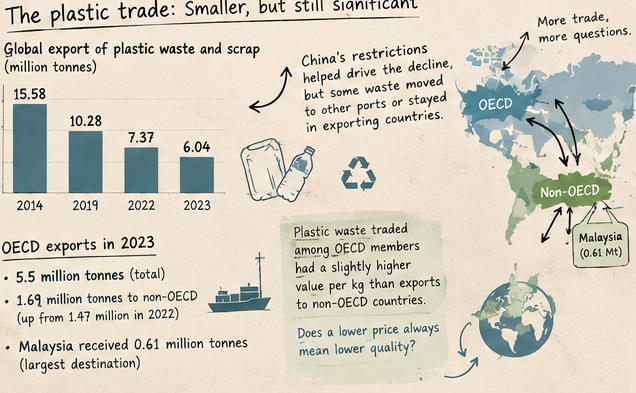
Yet the direction of some shipments still deserves attention. OECD members exported 5.5 million tonnes of plastic waste and scrap in 2023. Their exports to non-OECD countries rose from 1.47 million tonnes in 2022 to 1.69 million tonnes in 2023. Malaysia received 0.61 million tonnes from all origins and became the largest destination that year [1]. These figures describe trade volumes, not the amount illegally dumped after arrival. They tell us where to investigate capacity, oversight and the fate of rejected material.
The OECD also found that plastic waste traded among its members tended to have a slightly higher value per kilogram than exports to non-OECD countries. It suggests a possible difference in material quality or ease of recycling. Price alone cannot prove that every lower-priced shipment is contaminated [1]. It does, however, raise a fair question about which countries receive material that costs more to sort.
The electronics ledger
Electronics contain metals worth recovering and substances that can harm people when handled badly. The Global E-waste Monitor valued the metals embedded in the e-waste generated during 2022 at about $91 billion. It estimated that documented recycling reclaimed about $28 billion in secondary raw materials. The report also calculated a net global economic cost of about $37 billion for the prevailing management of e-waste, after accounting for benefits, treatment expenses and external harm [2]. These measures describe different things. The value contained in a discarded device is not the same as the value recovered from it.

The people taking a device apart may see only a small portion of that value. Burning insulated wire can expose workers and surrounding communities to toxic substances. Safe disassembly, collection and processing require money, training and equipment. When the market rewards recovered metal while leaving those expenses unpaid, an apparently profitable transaction can carry an enormous social bill [2][3].
This is also why it is misleading to treat the undocumented share of global e-waste as one vast illegal shipment. Some devices remain in homes or storage. Others enter domestic waste streams or informal markets. The report nevertheless estimates that 3.3 million tonnes of e-waste moved from high-income to middle- and low-income countries through uncontrolled or undocumented cross-border routes in 2022 [2]. That finding warrants scrutiny on its own terms.
What a clothing bale conceals
In Accra, Kantamanto Market supports an enormous network of traders, tailors, repairers and resellers. The Or Foundation estimates that around 15 million secondhand garments arrive each week. Its research suggests roughly 40 percent of the millions of items passing through the market leave it as waste [4]. Clothing becomes unsellable at different points, including after traders have spent time sorting and repairing it.
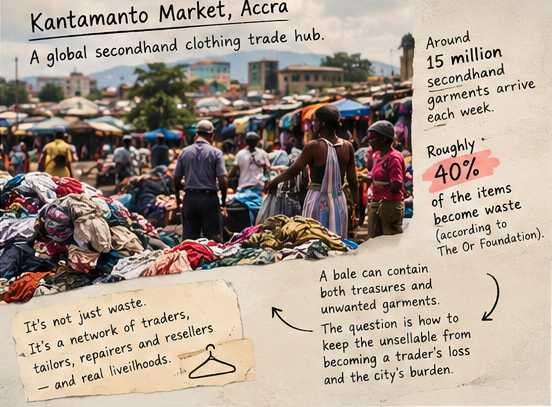
A bale can contain desirable clothes and garments that require repair or cannot be sold. Traders often pay before they can inspect each item. They generate value from what can be reused, then face the expense of the remainder. Calling the entire shipment a donation erases the commercial transaction and the labor that gives used clothing another life. Calling every garment in it waste erases the same labor. The question is how to keep unsellable material from becoming the trader’s private loss and the city’s public burden.
The Or Foundation describes Kantamanto as a major reuse hub where thousands of people sort, mend and remake clothing [4]. Their expertise belongs in any proposal to change this trade. Rules drafted far from Accra can harm livelihoods if they address imports without giving workers and municipalities the means to manage what is already arriving.
An honest account of choice

Receiving countries do make trade decisions. Some want access to secondary materials and can process them responsibly. The European Commission reported that non-OECD countries had applied to continue receiving certain non-hazardous waste from the EU under its revised rules [5]. It would be wrong to write these countries as passive destinations with no economic interests of their own.
Choice still depends on the terms offered. Can an importer inspect a shipment before accepting liability? Can it reject contaminated loads and recover the cost of returning them? Are workers protected and local authorities funded to handle residues? Those questions show where the economic imbalance lies more clearly than a blanket judgment on all cross-border waste trade.
Governments are tightening some rules. The EU prohibited exports of e-waste to non-OECD countries from January 2025 and is due to prohibit plastic waste exports to those countries from 21 November 2026, subject to the regulation’s later review process [6]. Such restrictions can reduce dangerous routes. They cannot replace investment in collection, repair and recycling at home or in importing countries.
UNEP estimated the direct global cost of municipal waste management at $252 billion in 2020 and $361 billion once pollution, health and climate costs were included. Those are worldwide municipal-waste figures, not the bill for exported waste alone [7]. They make one point unmistakable. Waste carries costs whether an invoice records them or not. A fairer trade begins when the parties earning from goods take responsibility for their end of life, and when workers and cities have the money and power to refuse an unfair deal.

Sources
[1] OECD, Why is the OECD monitoring trade in plastic waste and scrap, 2025 Read source
[2] UNITAR and ITU, The Global E-waste Monitor 2024 Read source
[3] World Health Organization, Electronic waste and children’s health Read source
[4] The Or Foundation, Dead White Man’s Clothes and Kantamanto research Read source
[5] European Commission, Requests to import non-hazardous EU waste, 2025 Read source
[6] European Commission, Waste shipments and implementation timeline Read source
[7] UNEP, Global Waste Management Outlook 2024 Read source


Comments